

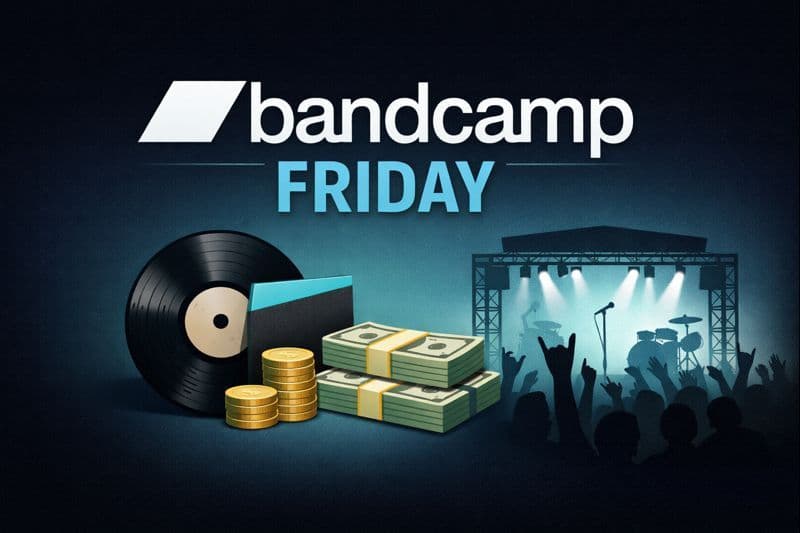
$154 Million and a Quiet Revolution: How Bandcamp Friday Changed the Economics of Independent Music
When Bandcamp announced that artists and labels had earned $154 million through the Bandcamp Friday initiative since its launch in March 2020, the figure itself told only part of the story. The real significance lies not in the number, but in what it represents: a rare structural correction in the way value flows through the modern music industry. Bandcamp Friday was born in a moment of crisis. Live music collapsed overnight. Touring revenue disappeared. For thousands of independent artists, the traditional safety net simply didn’t exist. Bandcamp’s response was deceptively simple: once a month, the platform waived its revenue share, allowing 100% of fan payments to go directly to artists and labels. What followed was not a temporary charity gesture, but a long-term behavioral shift. Direct Value, Restored Streaming normalized a model where music is consumed endlessly but compensated minimally. Bandcamp Friday interrupted that logic. It reminded fans that music has tangible value — and that paying for it can be intentional, not passive. The result was striking. Fans didn’t just buy more music; they bought differently. Full albums instead of singles. Vinyl instead of streams. Merch alongside digital releases. Purchases became acts of support rather than background consumption. For artists, the difference was immediate and measurable. A single Bandcamp Friday could generate revenue equivalent to months of streaming income. For labels, it provided liquidity — something rare in an industry dominated by delayed payouts and opaque accounting. Why $154 Million Matters More Than It Sounds In the context of global music revenues, $154 million may seem modest. But context is everything. This money did not flow through intermediaries, financial structures, or speculative instruments. It went directly from listener to creator. That makes it one of the most efficient revenue channels in modern music. More importantly, the initiative proved something the industry often resists acknowledging: fans are willing to pay when they understand where their money goes. Transparency created trust. Trust created action. Bandcamp Friday didn’t invent this principle — it validated it at scale. A Cultural Shift Disguised as a Platform Feature What makes Bandcamp Friday remarkable is that it didn’t rely on aggressive marketing or artificial urgency. There were no countdown timers, no algorithmic pressure, no gamified manipulation. Just a clear message: today, your money goes entirely to the artist. That clarity turned Bandcamp Friday into a recurring ritual. A date artists planned releases around. A moment fans remembered. Over time, it became part of the cultural calendar of independent music. The platform didn’t ask artists to compete harder for attention. It gave them a fairer playing field. The Long-Term Impact on Independent Careers The financial impact is only one layer. Equally important is what Bandcamp Friday enabled artists to do with that income. Artists paid rent. Funded recordings. Pressed vinyl. Covered mastering costs. Some simply bought time — time to keep making music instead of abandoning it. In an industry where sustainability is often discussed but rarely implemented, Bandcamp Friday functioned as infrastructure, not ideology. Why This Model Still Matters Bandcamp Friday did not replace streaming. It complemented it. It created an alternative revenue pillar that values depth over scale, connection over reach. Its success challenges a core assumption of the digital music economy: that artists must accept minimal margins in exchange for exposure. Bandcamp proved that direct support and global reach are not mutually exclusive. The $154 million figure is not just a milestone. It is evidence that a different economic relationship between artists and audiences is possible — and scalable. Conclusion: A Reminder the Industry Needed Bandcamp Friday succeeded not because it was revolutionary in design, but because it was honest in intent. It aligned incentives. It respected creators. It trusted listeners. In a business often defined by extraction and asymmetry, Bandcamp Friday offered something quietly radical: fairness. And $154 million later, it’s clear that when artists are treated as partners rather than content, the ecosystem doesn’t collapse — it grows stronger.